
Best Time to Trek Mount Batur: Month-by-Month Guide 2026
Ask any guide in Kintamani when the best time to trek Mount Batur is, and you’ll get a different answer depending on who you ask. Some say dry season, some swear by the quieter wet season mornings. After 10 years of guiding over 9,000 trekkers to the summit, I’ve learned the truth: every month has its sweet spot. The question isn’t “when is best?” but “what do you want out of your trek?”
If you’re still deciding whether this hike is for you, start with our complete Mount Batur trekking guide to understand the difficulty and hour-by-hour itinerary.
This guide breaks down every single month — weather patterns, cloud cover, crowd levels, and the specific days of the week that give you the quietest trails. Want golden skies and zero crowds? I’ll tell you exactly when to go. Planning a trip during peak season? Here’s how to avoid the masses. Ready to book? See our sunrise trekking packages and check live availability.
The Two Seasons of Bali (And Why They Matter for Trekking)
Bali has two distinct seasons, and they shape your Mount Batur experience differently than you might expect. Here’s what you actually need to know:
Dry Season: April – October
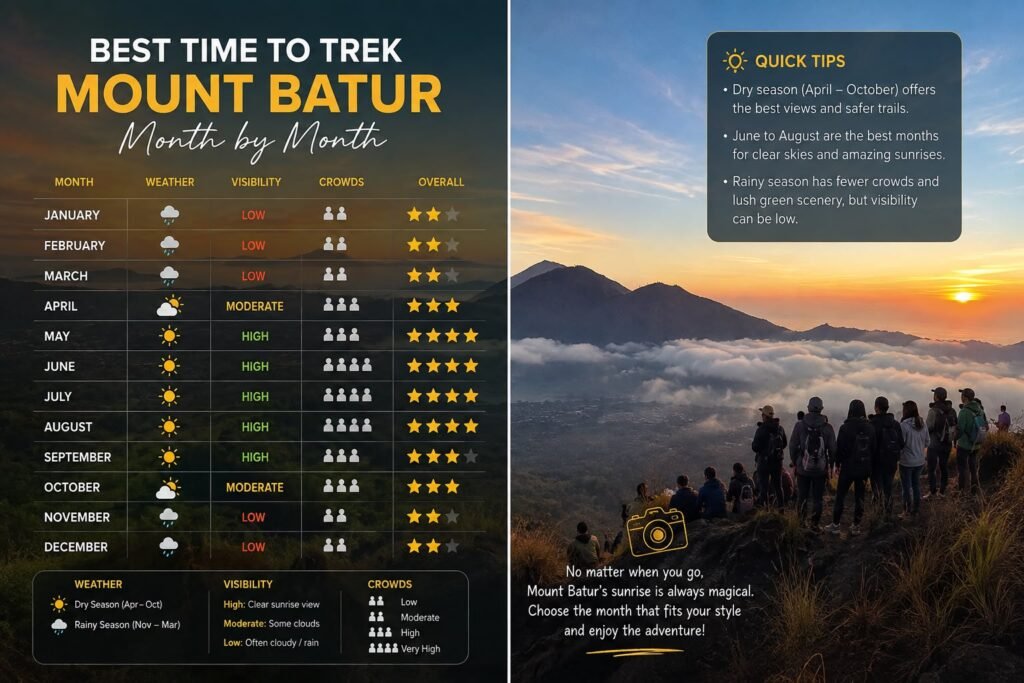
This is peak trekking season for a reason. Mornings are reliably clear, humidity drops, and sunrise visibility hits 85–90%. The trade-off: the trail gets busier. July and August especially can feel crowded at the summit viewpoint — not unpleasant, but you’re definitely sharing the moment.
Best months within dry season: May, June, September. These three hit the sweet spot — dry conditions, fewer tourists than July/August peak, and lush green slopes from the just-finished wet season.
Wet Season: November – March
Here’s what most travel blogs get wrong about wet season: rain almost never falls in the early morning. Bali’s rain comes in the afternoon — typically 2–6 PM — when you’re already back at your hotel. The pre-dawn trek is usually dry, and the misty caldera views are genuinely more dramatic than anything dry season offers.
The trade-off: cloud cover can obscure sunrise. About 30% of wet-season mornings are cloudy at 6:15 AM. But when it clears? You get the caldera framed by wispy clouds that look like something from a fantasy film.
Best months within wet season: April shoulder (early April), October shoulder (late October), and late December through early January.
Month-by-Month Breakdown
January: Wet Season, Quiet Trails
Weather: Wet. Average temperature 10–14°C at summit. Rain probability at sunrise: ~30%.
Crowds: Low. You might share the summit with 30–40 trekkers total (vs 200+ in July).
Verdict: Excellent for solitude-seekers. Pack waterproof jacket. If sunrise is cloudy, the mist over Lake Batur compensates.
Pro tip: Avoid January 1–5. New Year tourists flood the trail. Mid-to-late January is your sweet spot.
February: Wet Season, Quietest Month
Weather: Wettest month of the year. Temperature 10–14°C at summit. Rain probability at sunrise: ~35%. Because summit temperatures drop to 10–14°C and wind chill is a factor, layering is critical. Make sure you pack the right outfit and layers before you book a wet-season date.
Crowds: Lowest of the year. You’ll often have the summit viewpoints to yourself.
Verdict: Photographer’s choice. Moody, misty, atmospheric. Bring a tripod if you want long-exposure shots of the caldera through clouds.
Pro tip: Lunar New Year (late Jan/early Feb) can spike numbers. Check the calendar.
March: Transition Month
Weather: Shifting from wet to dry. Temperature 11–15°C. Rain probability at sunrise: ~25%.
Crowds: Low to moderate. Still quiet, building toward peak season.
Verdict: Hidden gem. You get near-dry conditions with wet-season crowd levels. Best value month on the calendar.
April: Shoulder Season Sweet Spot
Weather: Mostly dry. Temperature 11–16°C. Rain probability at sunrise: ~15%.
Crowds: Moderate. Easter and Australian school holidays spike numbers mid-month.
Verdict: One of the best months of the year. Clear skies, moderate crowds, green landscape. Book first two weeks of April to dodge holiday rush.
Pro tip: Easter week (varies, usually early April) sees a 3x increase in bookings. Our small-group join trek caps at 6 people, but spots fill fast — book 2 weeks ahead.
May: Peak Dry, Pre-Peak Crowds
Weather: Dry. Temperature 12–16°C. Rain probability at sunrise: ~10%.
Crowds: Moderate. Not yet at July/August peak.
Verdict: Arguably the single best month of the year for trekking. Crystal-clear sunrises, comfortable temps, and you’re not fighting 200 people for a photo spot.
June: Dry Season Prime
Weather: Dry. Temperature 11–15°C. Rain probability at sunrise: ~8%.
Crowds: High. Australian winter holidays begin.
Verdict: Excellent conditions, higher crowds. If you want reliability and don’t mind sharing the summit, this is your month.
July: Peak Season
Weather: Dry. Temperature 10–14°C. Rain probability at sunrise: ~5%.
Crowds: Highest of the year. Summit viewpoints can feel crowded.
Verdict: Guaranteed clear skies but you’re sharing the experience. Our private sunrise trek gives you access to a less-visited viewpoint where crowds don’t matter.
Pro tip: Book minimum 3 weeks ahead in July. We sell out 4–5x per week.
August: Peak Season Continues
Weather: Dry. Temperature 10–14°C. Rain probability at sunrise: ~5%.
Crowds: High. European summer holidays add to Australian tourists.
Verdict: Same as July — clear, busy, book early. If you’re traveling in August, consider a weekday trek (Tue–Thu) to avoid weekend surge.
September: Golden Month
Weather: Dry. Temperature 11–16°C. Rain probability at sunrise: ~10%.
Crowds: Moderate. Post-peak season drop.
Verdict: The smart traveler’s pick. Still perfectly dry, dramatically fewer people, and the landscape is starting to green up with early rain. My personal favorite month.
October: Shoulder Season Magic
Weather: Transition. Temperature 12–16°C. Rain probability at sunrise: ~15%.
Crowds: Low to moderate. End-of-year lull.
Verdict: Underrated gem. Clear mornings, green slopes, quiet trails. Best month for combining trekking with other Bali activities without peak-season chaos.
November: Wet Season Begins
Weather: Early wet season. Temperature 12–16°C. Rain probability at sunrise: ~20%.
Crowds: Low. Tourist low season.
Verdict: Still great for trekking. Rain is mostly afternoon. You get wet-season solitude with mostly dry mornings.
December: Holiday Split
Weather: Wet. Temperature 11–15°C. Rain probability at sunrise: ~25%.
Crowds: Split — quiet first half, packed Dec 20–Jan 2.
Verdict: First two weeks of December: excellent. Christmas/New Year week: avoid unless you don’t mind crowds.
Best Days of the Week to Trek (Crowd Hack)
If you have flexibility, weekday treks are dramatically better than weekends. Here’s why:
- Monday–Thursday: Lowest crowds. Often half the trekkers of weekends.
- Friday: Moderate. Some long-weekend travelers start here.
- Saturday–Sunday: Highest crowds. Locals + weekend tourists pile on.
If you’re trekking in July or August, pick a Tuesday or Wednesday. You’ll have a completely different experience.
Full Moon vs New Moon
Yes, this matters for sunrise treks.
Full moon nights: Brighter pre-dawn trek. You can often turn off your headlamp for the last 30 minutes of ascent — the moon lights the trail enough to see. Magical experience, slightly more crowded (people book full moon treks intentionally).
New moon nights: Pitch black. Your headlamp is your only light. The stars are incredible above you (zero light pollution at 1,500m+). Quieter trail. If you’re into astrophotography, new moon is the play.
Check timeanddate.com moon phases for Bali to plan around your preference.
Special Conditions: Volcanic Alert Levels
Mount Batur is an active volcano monitored 24/7 by PVMBG (Indonesia’s volcanology authority). The alert levels range from Normal (Level 1) to Alert (Level 4).
Current status: Normal (Level 1). This means trekking is fully permitted and safe.
If the alert level ever changes to Level 2 or above, the trail closes immediately. You’d receive a full refund or free reschedule from us — no questions asked. We monitor the official status daily and proactively contact booked guests if anything changes.
Frequently Asked Questions
What’s the single best month to trek?
If I had to pick one: May. Crystal clear skies, comfortable temps, moderate crowds. If you want near-zero crowds, pick February (but accept higher cloud chance).
Can I trek in the rain?
We trek in light rain — the trail is fine. If there’s a severe weather warning or the mountain is officially closed, you get a full refund or free reschedule. We also monitor BMKG weather forecasts the night before.
What if my trek day is cloudy?
About 20–30% of mornings (especially wet season) are cloudy at sunrise. When it clears, the misty caldera views are often more dramatic than a clear sunrise. If sunrise is fully obscured, you still get breakfast on volcanic vents, the hike itself, and the experience. It’s rare for it to be fully grey all morning.
How far in advance should I book?
Peak season (June–August): Book 2–3 weeks ahead. Shoulder (April, May, September, October): Book 1–2 weeks ahead. Low season (November–March): Book a few days ahead, spots usually available. Check live availability on our booking page.
Does the hot spring work in wet season?
Yes, and it’s arguably better. Soaking in volcanic hot water while rain falls on the lake around you is a unique experience. The springs are covered, so you stay dry. Add hot spring to your trek at booking.
Ready to Pick Your Date?
Now you know the patterns — dry season reliability, wet season solitude, shoulder season sweet spots, and the weekday hack that cuts crowds in half. Pick the month that fits your travel plans, avoid the obvious crowd spikes, and book 1–3 weeks ahead depending on season.
Our sunrise trekking packages run 365 days a year with free rescheduling if weather doesn’t cooperate. Join Trek from IDR 350K, Private Trek from IDR 400K. See you on the summit.