

Is Mount Batur Jeep Sunrise Safe? Off-Road Conditions and What to Know
Mount Batur Jeep Sunrise is often chosen by travellers who want to enjoy the mountain before dawn without hiking all the way to the summit. The experience sounds simple: climb into a 4WD jeep, travel across the volcanic landscape and watch the sunrise. But because the route can include uneven, rocky and dusty terrain, a fair question is worth asking before booking: is a Mount Batur Jeep Sunrise tour safe?
The honest answer is that it can be a reasonable adventure when the trip is operated responsibly, the vehicle is suitable and maintained, the driver understands the route, and guests follow safety instructions. It is still an off-road activity, not a smooth sightseeing transfer. Conditions can change, and no tour operator can promise that every journey will be risk-free.
Is Mount Batur Jeep Sunrise safe?
A Mount Batur Jeep Sunrise tour can be suitable for many visitors, but safety depends on several factors: the condition of the vehicle, the driver’s experience, the route being used, weather and ground conditions, and the behaviour of passengers. The fact that a vehicle is a 4WD jeep does not automatically make every route or driving style safe.
Expect an adventure ride over uneven terrain. Depending on the route, you may encounter loose volcanic gravel, rocks, ruts, dusty sections, slopes and narrow stretches. The vehicle may bounce or move from side to side. That is part of the off-road setting, but it is also why passengers should remain seated, keep their hands and belongings secure, and avoid distracting the driver.
What makes the Mount Batur jeep route different?
On a normal paved road, the vehicle usually travels on a relatively predictable surface. An off-road route is different. The ground may be uneven, loose or rutted, and the driver may need to adjust speed and steering as the surface changes. Even at a modest speed, passengers can feel movement through the vehicle.
Uneven volcanic ground
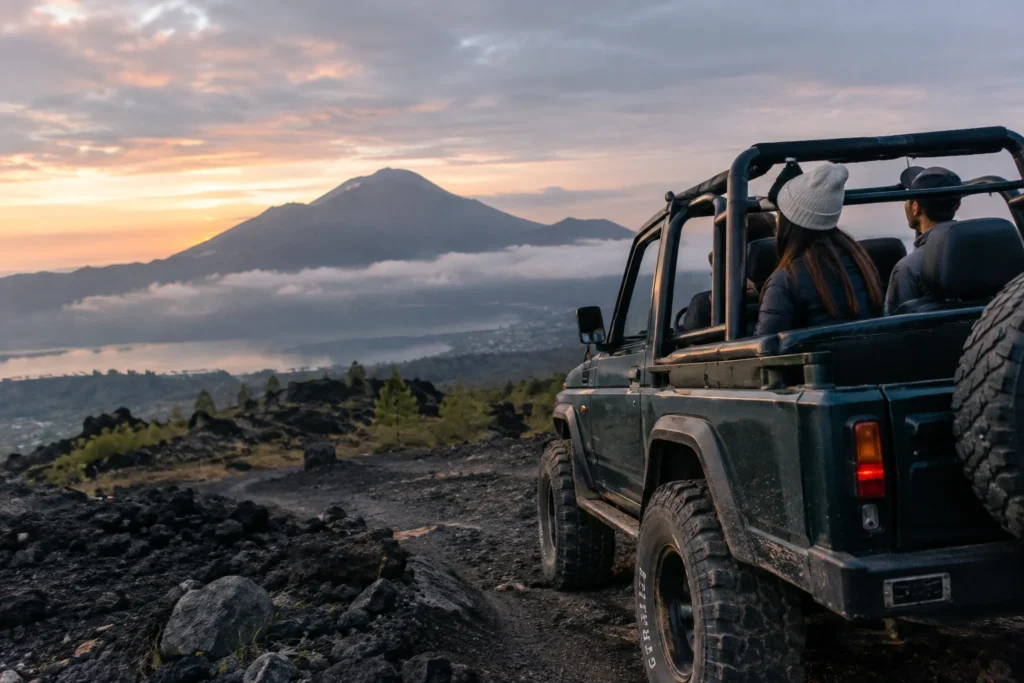
Parts of the Mount Batur landscape include volcanic rock, gravel and dark ash-like material. The surface can vary from one section to another. A track that feels firm in one place may be looser or rougher a short distance later. Passengers should expect bumps rather than a smooth ride.
Dust and reduced visibility
Dry ground can create dust when vehicles pass. This may affect visibility for drivers and other road users, particularly when several jeeps are travelling along the same section. Keeping a sensible following distance and avoiding unnecessary overtaking are important parts of responsible off-road driving.
Slopes, turns and narrow sections
Some off-road tracks can include gradients, bends or sections where there is limited room to manoeuvre. The driver should choose a speed and line appropriate to the terrain rather than trying to keep up with another vehicle. Passengers should not encourage racing, drifting or sudden manoeuvres for entertainment or photographs.
Darkness before sunrise
The journey begins before daylight, so the driver is working in low-light conditions. Headlights, visibility, route knowledge and attention matter. Passengers should avoid shining bright phone lights into the driver’s eyes and should not ask the driver to stop in an unsafe location just to capture a photograph.
What should you check about the jeep before booking?
- Ask whether the jeep is intended and equipped for the route being offered.
- Ask whether the vehicle is regularly checked and maintained.
- Confirm the number of guests and the total number of occupants.
- Ask whether seat belts are available for the passenger seats you will use.
- Check that the doors, seating and basic restraints work properly before departure.
- Ask what the operator does if a vehicle develops a mechanical problem during the trip.
Do not assume that every vehicle has the same layout. For the vehicle options described by this tour provider, a Standard Jeep carries up to four people in total including the driver, while a Long Jeep carries up to five people in total including the driver. That means up to three guests in a Standard Jeep and up to four guests in a Long Jeep. The larger vehicle costs more. Read the Standard vs Long Jeep capacity guide and make sure the confirmed vehicle matches your group.
If the vehicle appears visibly damaged, a door will not close, a seat is loose, or a seat belt that should be available does not work, raise the issue before setting off. Do not feel pressured to continue simply because the tour has already started. Ask the operator to resolve the concern or provide an appropriate alternative.
Why the driver matters so much
In an off-road experience, the driver is one of the most important safety factors. Knowing how to drive a vehicle on paved roads is not the same as understanding how it behaves on loose, uneven ground. A suitable driver should know the local route, recognise changing surface conditions, maintain control and be willing to slow down or stop when necessary.
Good driving is not about making the ride feel extreme. It is about choosing a controlled pace, leaving enough space between vehicles, avoiding unnecessary manoeuvres and putting passenger safety ahead of showing off. If a driver is using excessive speed, racing another jeep or making passengers uncomfortable with aggressive driving, tell the operator.
Do not distract the driver
Once the jeep is moving, avoid leaning forward to show the driver a phone, asking for sudden stops or trying to take photos from an unsafe position. If you need something, wait until the vehicle is stopped in a safe place. A driver who is concentrating on the track should not have to manage passengers reaching around the cabin.
How to stay safe as a passenger
Stay seated while the jeep is moving
Remain in your seat whenever the vehicle is moving. Do not stand, kneel on a seat, sit on a door frame or ride on an exterior step. Never hang out of the vehicle to take a photograph. A sudden bump or turn can cause a passenger to lose balance.
Use available seat belts
If a seat belt is fitted for your seat, wear it and make sure it is secured correctly. If the belt is damaged or will not latch, tell the driver or operator before departure. Do not assume that holding on to a handle is an equivalent substitute for a working restraint.
Keep hands, feet and head inside
Keep your body inside the vehicle while it is moving. Avoid placing hands or feet outside the cabin, even when the jeep is moving slowly. Branches, rocks, other vehicles and sudden movement can create hazards close to the track.
Secure phones, cameras and bags
Loose objects can move around when the jeep crosses rough ground. Put cameras, phones and small bags somewhere secure before the vehicle starts moving. Use a strap where appropriate, but do not let a camera strap dangle outside the vehicle. Large or heavy items should be discussed with the operator before the trip.
Follow instructions when getting in and out
Wait until the jeep has fully stopped and the driver indicates that it is safe to get out. Watch your footing because volcanic gravel and uneven rocks can shift under your shoes. Do not step into the path of another moving vehicle or walk behind a jeep that is reversing.
Is the ride suitable for children, older adults or pregnant travellers?
A jeep tour avoids the sustained uphill effort of a summit hike, but that does not automatically make it suitable for every person. The off-road ride can be bumpy, and getting in and out of the vehicle may involve awkward steps or uneven ground. Personal health, mobility, age, pregnancy and the exact vehicle arrangement all matter.
Travelling with children
Tell the operator the ages of all children before booking. Ask about the seating arrangement, available seat belts and whether any suitable child restraint can be provided. Do not assume that a child can sit on an adult’s lap or be excluded from the stated passenger capacity. If the operator cannot explain how the children will be seated safely, reconsider the arrangement.
Older adults and guests with mobility concerns
Some older adults enjoy the jeep experience, but age alone does not determine suitability. The key questions are whether the person can get into and out of the vehicle, tolerate a bumpy ride and manage any short walk at the viewpoint. Our guide about Mount Batur Jeep Sunrise for older adults discusses comfort and practical considerations in more detail.
Pregnancy and medical conditions
Off-road travel can involve repeated jolts. If you are pregnant, have a back or neck condition, recent surgery, a heart or balance problem, or another medical concern that could be affected by a bumpy ride, seek advice from a qualified healthcare professional before booking. Tell the operator about relevant restrictions and do not rely on a general statement that the tour is “easy” or “suitable for everyone.”
What if it rains or the track becomes slippery?
Rain can change the surface of an off-road track. Loose material may become muddy, traction can change and visibility may be reduced. Whether a tour proceeds depends on the actual conditions, local access decisions and the operator’s safety assessment. A booking should never be treated as a reason to continue when the route is unsafe.
Ask the operator how they make a go/no-go decision and what happens if conditions are unsuitable. The answer may involve delaying, changing the route, cancelling or offering another arrangement, depending on the provider’s policy. Get the relevant cancellation or rescheduling terms before payment.
For the separate question of whether cloud and rain affect the sunrise view, see our Mount Batur Jeep guide to bad weather. That article focuses on visibility and expectations rather than vehicle safety.
Volcanic activity and local access restrictions
Mount Batur is an active volcano, so the safety picture is not limited to the jeep and the road surface. Volcanic activity, gas emissions, local restrictions and official recommendations can affect where visitors may go. A normal-looking morning does not replace checking current official information.
Before travelling, check the latest information and recommendations from Indonesia’s Centre for Volcanology and Geological Hazard Mitigation (PVMBG), including its official MAGMA Indonesia reporting channels. Follow local authorities and the operator if access is restricted or an area is closed. Do not enter a restricted zone because another visitor has posted a photograph from there.
For general disaster and volcano information, the Indonesian National Disaster Management Agency (BNPB) provides official public information. The Directorate General of Land Transportation’s safety guidance also reinforces a useful principle: even a short journey deserves basic vehicle and passenger safety checks. These sources provide general safety context; they do not certify a particular jeep operator or route.
What should happen if the jeep has a problem?
If the vehicle develops an unusual noise, warning light, steering problem or other concern, tell the driver. If the driver decides to stop, remain in a safe location and follow instructions. Do not attempt to push, repair or inspect the vehicle on a slope or in the path of other traffic. Passengers should not get out until the driver confirms that it is safe.
How to choose a responsible Jeep Sunrise operator
- Check that the operator clearly identifies the vehicle type and guest capacity.
- Ask whether passenger seat belts are available and working.
- Ask how vehicles are maintained and what happens if one breaks down.
- Confirm that the driver is familiar with the route and local conditions.
- Ask how weather, volcanic alerts and local closures affect the itinerary.
- Check the cancellation, delay and alternative-route policy.
- Make sure the package inclusions and pickup arrangements are written clearly.
What to wear and bring for a safer ride
Frequently asked questions
Is Mount Batur Jeep Sunrise dangerous?
It is an off-road adventure and carries risks associated with uneven terrain, vehicle movement, weather and changing access conditions. A responsible operator, suitable vehicle, careful driving and sensible passenger behaviour can help manage those risks, but no tour is completely risk-free.
Is the Mount Batur jeep ride very bumpy?
It can be. The route may include rocky, loose or uneven sections, so expect movement and occasional jolts rather than a smooth road transfer. The exact ride depends on the route and conditions on the day.
Do jeep passengers need to wear seat belts?
Use a seat belt whenever one is fitted for your seat. Check that it works before departure and raise any problem with the operator. Ask about passenger restraints when booking rather than assuming every vehicle has the same layout.
Can children join a Mount Batur Jeep Sunrise tour?
Suitability depends on the child’s age, the vehicle’s seating and restraint arrangements, the route and the operator’s policy. Share the children’s ages before booking and confirm how each child will be seated safely.
Is the jeep tour suitable for pregnant travellers?
The off-road ride may involve repeated jolts. Pregnant travellers should seek individual medical advice and discuss the route with the operator before booking. Do not assume that avoiding the hike makes the jeep ride suitable during pregnancy.
What happens if the jeep breaks down?
Ask the operator before booking what recovery or replacement-vehicle arrangements are available. If a problem occurs during the trip, follow the driver’s instructions and wait in a safe place until assistance is arranged.
Will the tour continue in heavy rain?
Not necessarily. Rain can affect traction and visibility. The operator should assess actual conditions and follow local restrictions. Ask about delays, alternative routes, cancellations and rescheduling before paying.
Can I stand up in the jeep to take photos?
No. Stay seated with your body inside the vehicle while it is moving. Ask the driver to stop at a safe, permitted place before getting out to take photographs.
Does a 4WD jeep guarantee a safe trip?
No. Four-wheel drive is a vehicle capability, not a guarantee of safety. Vehicle condition, tyres, driver judgement, route conditions and passenger behaviour all matter.
Does the jeep drive to Mount Batur’s summit?
No. The usual jeep sunrise experience goes to a designated viewing area in the volcanic landscape, not to the actual summit. Reaching the summit is a separate trekking experience.
Final thoughts: enjoy the adventure without ignoring the basics
Mount Batur Jeep Sunrise can be an exciting way to experience Bali’s volcanic highlands before dawn, especially if you prefer a vehicle-based outing to a long uphill hike. But it is still an off-road journey. Choose an operator who answers safety questions clearly, check the vehicle and passenger arrangements, follow the driver’s instructions and respect local access restrictions.
The best trip is not the one with the roughest ride or the most dramatic driving. It is the one that gets everyone to the viewpoint and back with the experience they came for. If you are ready to plan your outing, explore our Mount Batur sunrise jeep experiences and confirm your preferred date, guest count and pickup details through the booking page.