

Mount Batur Sunrise Trekking in the Rainy Season: What to Expect
Rain in Bali does not automatically mean your Mount Batur sunrise trek is off. The island’s wet season brings greener hillsides, passing showers and more changeable skies, but conditions around the mountain can be different from the weather at your hotel. Some mornings are clear after an overnight shower; others begin with low cloud, slippery ground or persistent rain. The important thing is knowing what changes, what stays enjoyable, and when safety should come before the sunrise.
This guide explains what Mount Batur sunrise trekking is like during the rainy season, how rain affects the trail, what to pack, how to read the forecast and what questions to ask before booking. It is written for travellers who want a realistic plan rather than a promise that every dawn will look like a postcard.
Can You Trek Mount Batur During Bali’s Rainy Season?
Yes, trekking can take place during parts of Bali’s rainy season, provided local conditions and safety decisions allow it. Rainy season is not one continuous period of heavy rain. Weather can change from day to day and even within a single morning. A shower in the afternoon does not necessarily mean it will rain at the summit before dawn.
However, a trek should never go ahead simply because it has been booked. Heavy rain, thunderstorms, poor visibility, strong wind, unstable ground or official restrictions may make the route unsuitable. Local guides and authorities are best placed to assess conditions on the day. A responsible operator should explain the options if the weather makes the planned route unsafe.
If you are comparing seasons, remember that the dry season does not guarantee a clear sunrise either. Cloud and mist can appear in the highlands at any time. Our guide to why Kintamani gets misty explains how highland cloud and visibility can affect the view.
When Is the Rainy Season in Bali?
Bali generally experiences a wetter period around the end of the year and the beginning of the next, although the exact start, intensity and duration vary. It is better to treat seasonal dates as a broad planning guide than a fixed timetable. Climate patterns can shift, and one year may not follow the same pattern as the last.
Bali’s wetter period generally falls around the end of the year and the beginning of the next, but the timing and intensity vary across the island. Seasonal outlooks describe broad regional patterns rather than the weather at a particular trail or on a specific morning. For your trekking date, check the latest local forecast instead of relying on a seasonal calendar.
For a specific trekking date, use a current forecast for Kintamani rather than relying on a general Bali forecast. The BMKG forecast for Kintamani provides local village-level information. Forecasts are updated and can change, so check again close to departure.
What Changes on the Mount Batur Trail When It Rains?
The route does not become a completely different mountain, but rain changes the way the ground feels underfoot. Mount Batur’s trekking paths include sections of compacted earth, volcanic sand, loose stones and uneven natural surfaces. When wet, some areas can become slippery, especially where fine material sits over rock or where water runs across the trail.
1. Loose volcanic material can become unstable
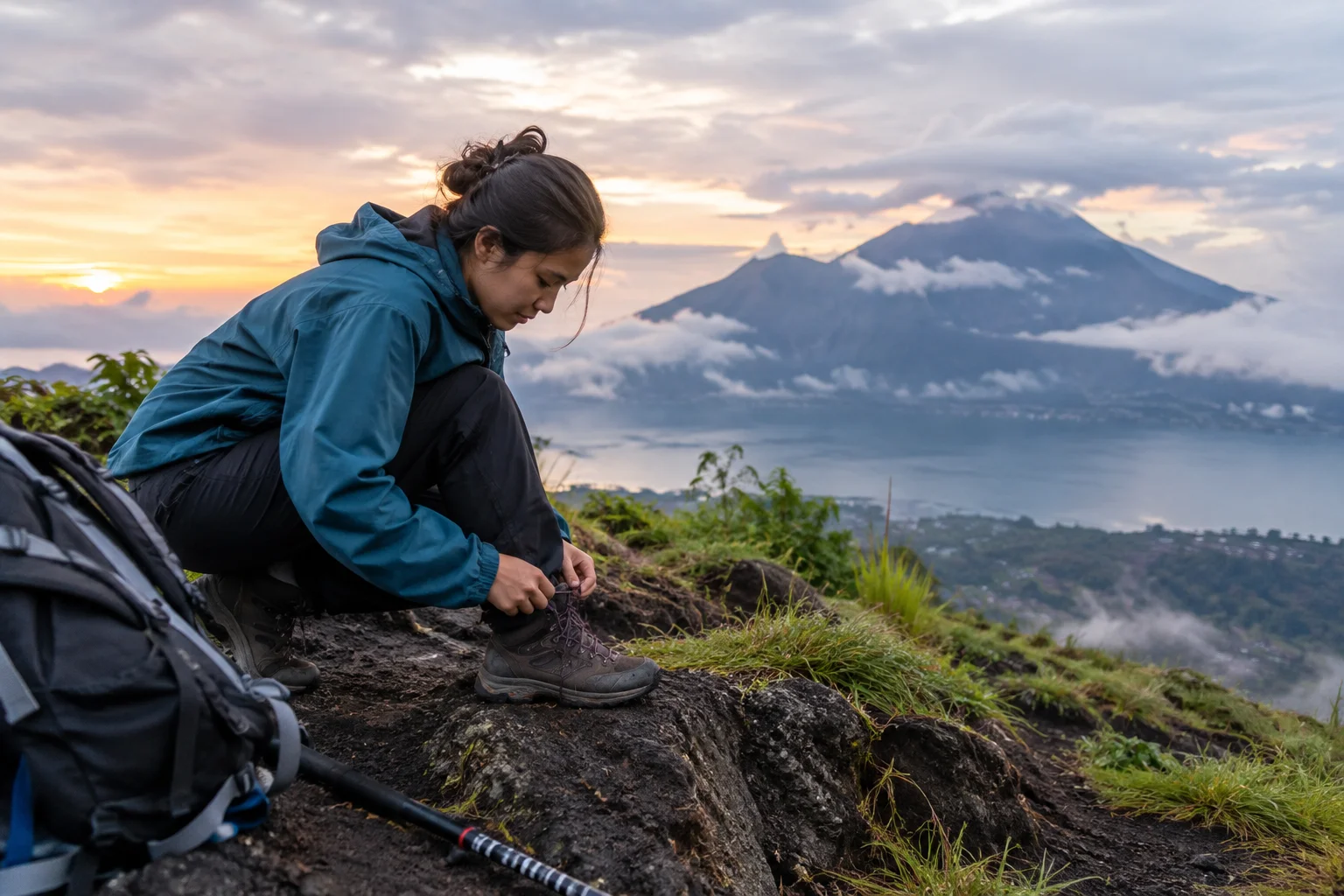
Dry volcanic sand and small stones already require careful footing. After rain, the surface may feel softer or more slippery, and a footstep that felt secure on a dry morning may shift. Walk at a steady pace, avoid rushing to catch up with another group and follow the guide’s choice of route. Good footwear with reliable grip is more useful than trying to move quickly.
2. Rocks and steeper sections need extra attention
Rocky steps and uneven sections can be slick when wet. Use the trekking pole if one is provided, keep your hands free when possible and take shorter steps on descents. Do not jump from rock to rock or try to pass other hikers on narrow sections. If the guide asks the group to slow down or wait, there is usually a practical reason.
3. The trail may be muddy in places
Some sections can hold water or become muddy after sustained rain. Mud can cling to shoe soles and reduce grip, so stop safely to clear it if necessary. Avoid stepping onto fragile vegetation at the side of the path just to get around a puddle. Stay on the route indicated by your guide.
4. Visibility can change quickly
Low cloud or mist may reduce the view of the surrounding caldera, lake and neighbouring peaks. Sometimes the sky opens for a short period; sometimes the landscape remains hidden. Do not walk away from the group or approach an exposed edge to search for a better view. In poor visibility, staying together and following the guide matters more than getting a photograph.
Will You Still See the Sunrise in the Rainy Season?
Possibly, but no operator can honestly guarantee it. Sunrise visibility depends on cloud height, cloud thickness, rain, wind and the weather pattern across the highlands. A forecast showing rain in Kintamani does not always mean rain will fall continuously at the viewpoint, just as a forecast showing partly cloudy conditions cannot promise an unobstructed horizon.
There are several possible outcomes. You might enjoy a clear horizon with dramatic clouds around the volcano. You might see the sky brighten through gaps in the cloud. You might get a moody, mist-covered landscape with only brief views of the lake. Or the cloud may be thick enough to hide the sunrise altogether.
It helps to adjust the goal. The experience is not only the moment the sun appears. The pre-dawn atmosphere, the changing light, the volcanic terrain and the feeling of being high above the surrounding landscape can still make the morning worthwhile. But if seeing a clear sunrise is your absolute priority, allow flexibility in your Bali itinerary so you have another possible morning rather than placing everything on one date.
What Should You Pack for a Rainy-Season Trek?
Pack for a cool, damp morning rather than a beach day. You do not need to carry your entire suitcase up the mountain; a small bag with practical essentials is enough.
- Light waterproof jacket: Choose a breathable rain jacket that can also block wind. A thin plastic poncho is better than nothing but can flap around and make movement awkward.
- Quick-drying layers: Wear a moisture-wicking top and a light warm layer. Avoid relying on cotton alone because it stays damp longer.
- Closed-toe shoes with grip: Trail shoes or sturdy trainers with a good tread are preferable to smooth-soled sneakers, sandals or fashion shoes.
- Small dry bag or waterproof pouch: Protect your phone, cash and other essentials from rain.
- Spare socks: A dry pair can make the return journey much more comfortable.
- Water and a small snack: Bring drinking water and check what refreshments are included in your package.
- Headlamp: The trek begins in darkness. Confirm whether a light is provided or bring your own.
- Personal medication: Carry any medication you normally need, stored in a waterproof pouch.
For a broader packing checklist, see our Mount Batur adventure packing guide. Some advice applies to both trekking and Jeep trips, although trekking footwear and rain protection deserve particular attention on foot.
How to Prepare Your Body and Pace Yourself
Wet conditions are not the time to prove how fast you can climb. A controlled pace helps you keep your balance, manage your breathing and notice changes in the trail. Start slowly, especially during the first part of the ascent when it is dark and your eyes are still adjusting.
Take small steps on loose or slippery ground. Keep a little space between yourself and the person ahead so you are not forced to follow their exact foot placement. When stopping, move to a safe place where you are not blocking the path. Tell your guide if you feel dizzy, unusually breathless, unwell or uncomfortable with the conditions.
If you have a medical condition, a recent injury or concerns about walking on uneven ground, consider getting medical advice before booking and explain your situation to the operator. Rain can make a moderate route more demanding. Our article Is Mount Batur hard? gives a realistic overview of the effort involved.
When Should a Trek Be Postponed or Stopped?
There is a difference between an ordinary shower and conditions that make a mountain route unsafe. Persistent heavy rain, thunder and lightning, strong gusts, very poor visibility, water flowing across the path, or signs of unstable ground should be taken seriously. A guide may change the route, wait for conditions to improve, turn the group around or cancel the trek.
Lightning deserves particular caution on exposed high ground. Do not insist on continuing towards a summit or viewpoint during a thunderstorm. Likewise, if the guide says a section is too slippery or visibility is too poor, do not attempt to continue independently. The safest decision may mean missing the sunrise.
Ask the operator before booking how weather-related changes are handled. Policies differ, and cancellation or rescheduling terms should be clear before payment. Confirm whether a change is based on the guide’s safety assessment, local authority instructions or the operator’s own policy. Do not assume every company offers a free alternative date.
Should You Book in Advance or Wait for the Forecast?
For popular travel dates, booking ahead can help secure your preferred package and pickup arrangement. But booking early does not make the weather predictable. A practical approach is to reserve with an operator whose weather policy is clear, then monitor the forecast during the days before your trek.
If your itinerary allows it, consider placing the trek earlier in your Bali stay rather than on your final morning. That gives you some flexibility if conditions require a change. Travellers with only one available morning should be especially careful to understand the operator’s policy before paying.
When you enquire, provide your date, number of participants and accommodation location. Ask whether the package is shared or private, what time pickup is expected, what equipment is supplied and what happens if the route is unsafe. You can review the available options on the Mount Batur trekking booking page and confirm the details that apply to your date.
Rainy Season Trekking vs. a Jeep Sunrise Tour
If you are worried about slippery trails, a Jeep sunrise experience may be an alternative worth considering. It avoids the uphill trek on foot, but it is not a weather-proof option. Jeep routes can also be affected by rain, muddy tracks, poor visibility and local access restrictions. The ride may be bumpy, and guests still need to get in and out of the vehicle and walk around at some stops.
Choose based on the experience you want and the conditions expected, not on the idea that one option guarantees a clear view. Our comparison of Mount Batur trekking and Jeep sunrise explains the differences in effort and experience. If you are interested in a vehicle-based trip, also read what happens on a Jeep sunrise tour in bad weather.
Is the Rainy Season a Bad Time to Visit Mount Batur?
Not necessarily. The rainy season can bring greener scenery, fresh air after showers and dramatic cloud formations around the caldera. It can also bring muddy paths, reduced visibility and more uncertainty. Whether it is a good time for you depends on your priorities and flexibility.
If you enjoy nature in changing conditions and are comfortable with the possibility of a cloudy morning, the season can still be rewarding. If you have a strict schedule and only want a clear sunrise photograph, the uncertainty may be frustrating. No month can guarantee perfect weather, so make your decision with realistic expectations.
For travellers who want to explore the mountain with a guide, discover our Mount Batur sunrise experiences and choose an option that suits your fitness, schedule and comfort level. The best trip is one where the plan is clear and safety is never treated as an optional extra.
Frequently Asked Questions
Can I climb Mount Batur in December?
It may be possible, depending on the weather and local conditions on your chosen date. December is generally within Bali’s wetter period, but rain is not continuous every day. Check the current Kintamani forecast and follow the guide’s assessment before departure.
Does it rain every morning during the rainy season?
No. Rainfall varies by day, location and time. A wet afternoon in another part of Bali does not tell you exactly what conditions will be like at Mount Batur before sunrise.
Is the Mount Batur trail dangerous when wet?
Wet ground can increase the risk of slipping, particularly on loose volcanic material, rocks and muddy sections. Conditions are not automatically unsafe after every shower, but the guide should assess the route and change plans if necessary.
Will the sunrise be visible if it is cloudy?
It may be partly visible through gaps in the cloud, or it may be completely hidden. Cloud cover can change quickly in the highlands, so no sunrise view should be guaranteed.
What shoes should I wear for a rainy-season trek?
Wear closed-toe shoes with a secure fit and a tread that provides good grip. Avoid smooth soles, loose sandals and shoes that become uncomfortable when wet.
Should I cancel my trek if the forecast shows rain?
Not automatically. Check the forecast close to the date and ask the operator for an update. Light rain and dangerous conditions are not the same thing. Follow local safety advice and the guide’s decision on the day.
Is a Jeep sunrise tour safer than trekking in the rain?
It removes the uphill walk, but it is not risk-free in poor weather. Rough tracks, mud, visibility and access restrictions can affect Jeep tours too. Ask about the route and weather policy before choosing.
Can I change my booking if the weather is bad?
That depends on the operator’s booking terms and the reason for the change. Ask about rescheduling, cancellation and refund conditions before you pay, and request the policy in writing.
Final Advice: Be Flexible, Prepared and Sensible
Mount Batur can still be a memorable experience during Bali’s rainy season, but it rewards preparation more than optimism. Bring proper footwear and rain protection, check a local forecast, understand the booking policy and give your guide room to make a safe decision. If the sky clears, enjoy the sunrise. If it does not, take in the mountain atmosphere and remember that the weather was never something anyone could control.
When planning your visit, choose an experience that fits your ability and schedule, and make sure the operator explains what is included and how weather-related changes are handled. A good mountain morning starts with sensible expectations long before the alarm goes off.