

Cycling in Kintamani: Scenic Routes, Volcanic Landscapes and What to Expect
There is a particular pleasure in seeing Bali slowly rather than through a car window. On a bicycle, the cool air of the Kintamani highlands, the changing shape of the Batur caldera and the small details of village life all become part of the journey. You notice the scent of coffee trees, the sound of a temple courtyard being swept, and the way the landscape shifts as the road leaves the high rim and heads towards lower villages.
Cycling in Kintamani is often associated with guided downhill rides from the highlands towards Ubud. These trips can be a relaxed way to experience rural Bali, but the area also offers more demanding rides for people who want to pedal uphill, follow the caldera roads or explore on a road bike. The important thing is to understand which kind of cycling experience you are booking. “Kintamani cycling” can describe several very different days in the saddle.
This guide explains the main ride styles, what the terrain is really like, how to choose a suitable route, what to wear, and how to ride respectfully through villages and farmland. It is written for visitors who want a practical picture before booking—not for anyone expecting every kilometre to be a perfectly smooth bicycle lane.
Why Go Cycling in Kintamani?
Kintamani offers a combination that is hard to find in one short ride: highland scenery, volcanic geography, rural roads, agricultural land and traditional settlements. The caldera rim provides wide views towards Mount Batur and Lake Batur, while routes heading away from the rim can pass through gardens, village roads and rice-growing areas.
The cooler highland climate can make an early start more comfortable than cycling in Bali’s hotter coastal districts. The scenery also changes noticeably as you descend. A ride may begin with open views across the volcanic basin and continue through greener, more enclosed countryside. That gradual transition is one of the reasons guided downhill trips are popular with first-time visitors.
Cycling also changes the pace of sightseeing. A driver can take you between attractions efficiently, but a bicycle lets you experience the spaces in between. You have time to notice small shrines, family compounds, roadside produce stalls and the everyday rhythm of a village. The Indonesian Ministry of Foreign Affairs’ Bali Travel Guidebook describes cycling and mountain biking as ways to explore countryside, rice fields and traditional villages while connecting with local life.
The Main Types of Kintamani Cycling Experience
1. Guided downhill cycling from Kintamani
This is the best-known format for casual visitors. A tour vehicle usually brings participants and bicycles to a highland starting point around Kintamani or the caldera rim. After a briefing and sometimes breakfast or a viewpoint stop, the group rides downhill or along gently descending rural roads towards the Ubud area.
Although the word “downhill” sounds like the entire ride is effortless, expect a mixture of gradients, flat sections, junctions and occasional short climbs. The route depends on the operator and road conditions. Some itineraries focus on quiet village lanes; others include stops at plantations, rice fields, temples or family compounds. A typical advertised ride may cover around 20–30 kilometres, but distance and duration vary, so confirm the actual route rather than assuming every tour follows the same track.
This option suits travellers who want a countryside experience without making a full day of strenuous climbing. It can work well for mixed-ability groups, provided every participant is confident controlling a bicycle and the operator has checked that the route is suitable for the group.
2. Caldera-rim and highland road cycling
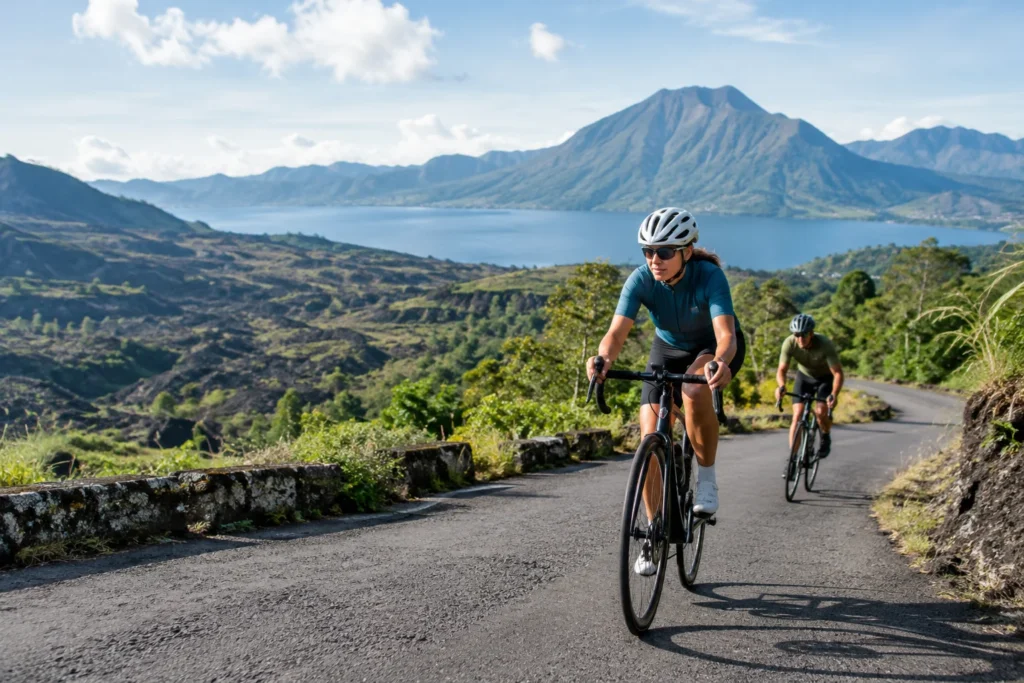
Riding around the Kintamani highlands is a different proposition. Instead of being transported to a high point and descending, you may be pedalling along undulating roads with views towards the caldera, Mount Batur and Lake Batur. Depending on the route, there can be sustained climbs, exposed sections and descents that require good braking control.
This style is better suited to cyclists who already understand road riding and are comfortable sharing narrow roads with motorbikes, cars and local traffic. The scenery can be excellent, but do not confuse a scenic road with a traffic-free cycling route. Check the surface, elevation gain, road width and traffic exposure before choosing a loop.
3. Mountain biking and off-road riding
Some cycling experiences in Bali use mountain bikes on trails or mixed surfaces. These are not automatically the same as the familiar Kintamani-to-Ubud downhill tours. A trail ride can involve loose volcanic gravel, uneven ground, ruts, stones, muddy sections or steep gradients. Ask the operator whether the route is genuinely off-road, what technical level is expected, and whether the bicycle and protective equipment are suitable.
If you are mainly interested in the volcanic landscape rather than a technical ride, a guided road-based downhill tour may be a better match. For more background on the area’s dark volcanic terrain, see our article about Mount Batur’s black lava fields. Those dramatic lava areas are not a signal to ride anywhere you like; access and permitted routes should always be confirmed locally.
How Difficult Is Cycling in Kintamani?
The difficulty depends more on the route than on the destination name. A guided downhill trip can be manageable for recreational cyclists who are comfortable riding for a few hours and controlling speed on descents. A self-planned caldera loop or a route with long climbs can be considerably harder.
Before booking, think about three different abilities:
- Basic cycling confidence: Can you start, stop, turn, look behind and ride in a straight line without feeling unstable?
- Braking and descending: Can you control your speed on a long slope without gripping the brakes continuously or losing confidence around bends?
- Road awareness: Can you anticipate motorbikes, parked vehicles, dogs, pedestrians, junctions and changes in road surface?
Being able to ride a bicycle on a quiet path does not automatically mean you will enjoy a long downhill route on public roads. Tell the operator honestly about your experience. A good guide should be willing to recommend a shorter or easier option rather than simply assuring everyone that the ride is suitable for all.
For families, ask about minimum age, minimum height, child-sized bicycles, child seats if relevant, and whether a parent can ride alongside a child. Do not rely on a general “family friendly” label without checking the actual route and equipment.
When Is the Best Time to Go Cycling in Kintamani?
Early morning is usually the most comfortable time to begin. The highlands are cooler, the day is still fresh and there is more flexibility before traffic and heat build later. Morning light can also make the caldera views particularly attractive, although cloud and mist are part of mountain weather and can change quickly.
Bali has a drier period and a wetter period, but rain does not follow a perfect timetable. During wetter months, roads may be slippery, visibility can be reduced and showers can affect the route. In drier months, loose dust and gravel may be more noticeable on some road edges. Neither season guarantees ideal conditions every day.
For a broader look at the local conditions, read our guide to Kintamani’s mist, clouds and changing visibility. If the forecast looks poor, ask the operator whether the tour will proceed, be modified or be rescheduled. A responsible decision is more important than forcing a ride because it was already on the holiday calendar.
What to Wear and Bring
You do not need professional racing kit for a recreational guided tour, but comfortable clothing and proper footwear matter. Choose breathable sportswear that allows free movement. Closed-toe shoes with a secure fit are preferable to sandals or loose footwear. Avoid wide trousers, dangling straps or anything that could catch in the chain or moving parts.
- Wear a properly fitted helmet supplied by the operator or bring your own.
- Use sunglasses and sunscreen; the highland sun can still be strong.
- Bring a light layer for the cooler start, especially if you are waiting at a viewpoint.
- Carry drinking water, or confirm how water is provided during the tour.
- Use comfortable gloves if you are accustomed to them, particularly for longer descents.
- Bring a small amount of cash for personal purchases, but keep valuables secure.
- Pack a light rain jacket during the wet season.
Ask whether the operator provides a helmet, bicycle, water, guide, support vehicle, lunch, insurance and hotel transfers. “All inclusive” can mean different things between companies, so check the written inclusions rather than relying on a short promotional headline.
Safety: What to Check Before You Ride
Most of the practical risks on a recreational Kintamani ride are familiar road-cycling risks: traffic, speed on descents, uneven surfaces, junctions and changing weather. The fact that a tour is guided does not remove the need to ride carefully. Listen to the briefing and follow the guide’s instructions, especially when the group approaches a bend, village junction or busy road.
Check the bicycle before departure
Take a moment to inspect the bicycle. The brakes should respond firmly, tyres should be inflated and free of obvious damage, the saddle should be adjusted to your height, and the gears should shift properly. Ask the guide to make any adjustments before the group leaves. If something feels wrong during the first few minutes, say so immediately rather than trying to tolerate it for the rest of the ride.
Control your speed on descents
Do not race other riders or follow too closely behind the person in front. Keep enough space to react if someone slows suddenly. Reduce speed before a bend, avoid abrupt steering on loose gravel, and never assume the road ahead is clear simply because the rider in front has passed. If you are uncomfortable, stop in a safe place and let the guide know.
Respect local traffic and road users
Keep left, ride predictably and use clear hand signals when appropriate. Do not spread across the full road for photographs. Be especially careful near parked vehicles, dogs, school areas, temple entrances and narrow bridges. A village road is part of the local transport network, not a closed cycling circuit.
Know when to stop
If you feel dizzy, unusually breathless, overheated or unwell, stop and tell the guide. Do not continue simply to avoid slowing the group. A good tour should allow reasonable breaks and should have a plan for a participant who cannot continue. Ask in advance whether the support vehicle can collect a rider and bicycle if necessary.
How to Choose a Kintamani Cycling Tour
Compare tours by route and service, not just by the lowest advertised price. A useful operator should be able to explain the route, estimated riding time, group size, equipment and what happens if weather or road conditions change.
Before confirming, ask these questions:
- Where exactly does the ride start and finish?
- How many kilometres will we ride, and how much is downhill, flat or uphill?
- Is the route mainly on public roads, village lanes or off-road trails?
- What is the maximum group size, and how many guides accompany the group?
- Are helmets and bicycles included, and can the bicycle size be adjusted?
- Is there a support vehicle, and can it collect someone who needs to stop?
- Are hotel transfers, breakfast, lunch, water and insurance included?
- What is the cancellation or rescheduling policy if it rains?
Look for recent reviews that mention guide attentiveness, bicycle condition and how the operator manages the group—not only comments about the scenery. A beautiful view is easy to promise. Reliable equipment and sensible supervision are more important.
Combining Cycling with Other Kintamani Experiences
A cycling tour can be the main activity of the day, but it can also fit into a wider visit if the timing and transfer arrangements allow. Some travellers prefer to enjoy the caldera view before riding, then finish with lunch or a relaxed stop around Ubud. Others may stay in the Kintamani area and explore the lake or local attractions on another day.
For route inspiration, read our guide to scenic stops around the Batur caldera and our overview of Kintamani’s highland farms and local produce. These guides add context to the landscapes you may pass, although your cycling operator may follow a different route.
If you have more time in the highlands, the Batur Geopark Museum offers a different way to understand the volcanic landscape. It is an educational stop rather than a cycling attraction, so plan it separately or ask your driver whether it fits comfortably around the ride.
Lake Batur is another natural extension to a longer stay. Our article on the importance of Lake Batur to local life gives more background on the lake and the communities around it. Avoid trying to squeeze too many stops into a cycling day; arriving back relaxed is better than turning the afternoon into a race against the clock.
Is Cycling in Kintamani Worth It?
For travellers who enjoy gentle adventure and want to see more than Bali’s famous viewpoints, cycling in Kintamani can be a rewarding choice. A guided downhill ride offers a relatively accessible way to move from the volcanic highlands into rural landscapes, while more challenging road and trail rides can suit experienced cyclists looking for a stronger physical outing.
The key is matching the route to your ability. Ask what the ride actually involves, check the equipment, understand the road conditions and choose a guide who takes safety seriously. If you do that, the day becomes about more than covering distance: it becomes a chance to experience the changing scenery and everyday life of Bali at bicycle speed.
Frequently Asked Questions
Is cycling in Kintamani suitable for beginners?
Some guided downhill tours are designed for recreational riders, but beginners still need to be confident starting, stopping, steering and braking. Ask about the route, traffic, descent length and minimum skill level before booking.
Is Kintamani cycling mostly downhill?
Many visitor tours use a downhill format from the highlands towards Ubud, but not every Kintamani cycling route is downhill. Caldera loops, road rides and mountain-bike routes can include significant climbs or technical sections.
Do I need to be very fit?
Not necessarily for a suitable guided downhill route, although you should be comfortable cycling for a few hours and controlling speed on descents. More demanding highland loops require better stamina and road-cycling experience.
What should I wear for cycling in Kintamani?
Wear comfortable sports clothing, closed-toe shoes and a properly fitted helmet. Bring sunscreen, sunglasses, water and a light jacket for the cool morning start. A rain jacket is useful in wetter months.
What happens if it rains?
Rain can make descents and village roads slippery and reduce visibility. Ask the operator whether it will modify, delay, reschedule or cancel the ride when conditions are unsafe.
Plan Your Kintamani Adventure
Cycling is one way to experience the highlands at a more human pace, from the volcanic views above Lake Batur to the villages and farms on the way down. Explore more local stories and trip ideas on the Mount Batur Sunrise Trekking website. If you are also considering a sunrise experience, check the details on our booking page and plan enough time between activities to enjoy each one properly.