

Kintamani Coffee: How Bali’s Highland Arabica Goes from Farm to Cup
In Kintamani, coffee is more than something served after breakfast. It is part of the highland landscape: coffee trees grow among other crops, farmers work across small plots, and the volcanic slopes around Mount Batur help shape the character of the region’s Arabica. For visitors, a cup of local coffee can be a delicious introduction to a side of Bali that is easy to miss when the trip is planned only around beaches and temples.
Kintamani coffee also has a recognised identity. Bali’s Arabica from this area received geographical indication protection, linking the product’s reputation to its place of origin and the people who cultivate it. But what does that mean for the flavour in your cup? Why is the region associated with citrus-like notes? How is the coffee grown and processed, and what should you look for when visiting a farm or buying a bag to take home?
This guide follows Kintamani coffee from the highland farm to the cup, with practical advice for travellers who want to understand the local product rather than simply take a quick tasting photo.
What Is Kintamani Coffee?
Kintamani coffee usually refers to Bali-grown Arabica associated with the Kintamani highlands in Bangli Regency. The protected geographical indication is known as Kopi Arabika Kintamani Bali. The official Bali intellectual-property information describes it as Arabica grown in the highlands, above roughly 900 metres, on the volcanic slopes of Mount Batur and surrounding areas.
A geographical indication is not just a fancy label. It identifies a product whose qualities or reputation are connected to a particular geographical origin. In this case, the name recognises the relationship between the coffee, its growing environment and the local farming community. The Bali provincial intellectual-property search record lists Kopi Arabika Kintamani Bali as a certified geographical indication. You can read the Bali government’s geographical-indication record for the registered product.
The registration does not mean every coffee sold in a Kintamani café automatically carries the protected identity. If origin matters to you, ask the seller whether the beans are locally sourced and whether the product is certified or traceable to the relevant producer group. A bag with a volcano printed on it is not, by itself, proof of where the beans were grown.
Why Does Coffee Grow Well in the Kintamani Highlands?
Arabica generally performs well in cooler highland environments compared with the hot lowlands. Kintamani’s elevation, local rainfall patterns, volcanic terrain and farming practices create conditions in which Arabica can be cultivated. The area is not one uniform plantation: farms are spread across villages and slopes, and conditions vary with elevation, aspect, shade and the way each plot is managed.
Highland elevation and cooler conditions
Many Kintamani coffee farms sit above 900 metres. Higher elevations tend to bring cooler temperatures than Bali’s coastal areas. For Arabica, this can influence how cherries develop and how quickly they ripen. The exact result depends on the farm and season, so elevation should be understood as one part of the growing environment, not a guarantee that every bean will taste the same.
Volcanic landscape and soil
The Batur area is shaped by a long volcanic history. Its landscape includes volcanic deposits, lava fields, caldera slopes and fertile agricultural areas. Soil conditions can influence plant nutrition and water movement, although it is too simplistic to say that all volcanic soil automatically produces better coffee. Farming decisions, plant health, harvesting and processing remain essential.
If you want to understand the wider landscape beneath the farms, our article on how the Batur caldera was formed gives useful geological background. The coffee story sits within that larger volcanic setting.
Intercropping and shade
In parts of Kintamani, coffee is grown alongside other crops and shade trees rather than in a single-crop plantation. This mixed-farming approach can make the farm more diverse and provide additional produce for households. Fruit trees and other plants may share the same plot, although the exact combination differs from one farmer to another.
What Does Kintamani Arabica Taste Like?
Kintamani Arabica is often associated with a clean acidity and citrus-like character, sometimes described with notes of orange or other fresh fruit. Depending on the beans and roast, you may also notice sweetness, gentle spice or a lighter body. These are tasting descriptions rather than ingredients added to the coffee. Your cup should not contain orange juice simply because someone describes it as citrusy.
The official Bali intellectual-property record describes a medium-roast profile with a sweet aroma, a little spice and, in some cases, fruit character such as squeezed citrus. That description is a useful reference, but not a promise that every roast will taste identical. Variety, altitude, harvest maturity, processing, storage, roasting and brewing all affect the final flavour.
If you are used to dark, smoky coffee, a lighter or medium-roasted Kintamani Arabica may taste noticeably brighter. Try it without sugar first, then add milk or sweetener if that is how you normally enjoy coffee. There is no coffee police waiting behind the tasting table.
From Red Cherry to Green Bean: How Kintamani Coffee Is Harvested
Coffee begins as a fruit. The beans are the seeds inside the coffee cherry, and the quality of the final drink depends partly on how those cherries are selected and handled. Harvesting practices vary between farms, but ripe cherries are generally preferred for higher-quality lots because they have developed more fully on the plant.
Picking ripe cherries
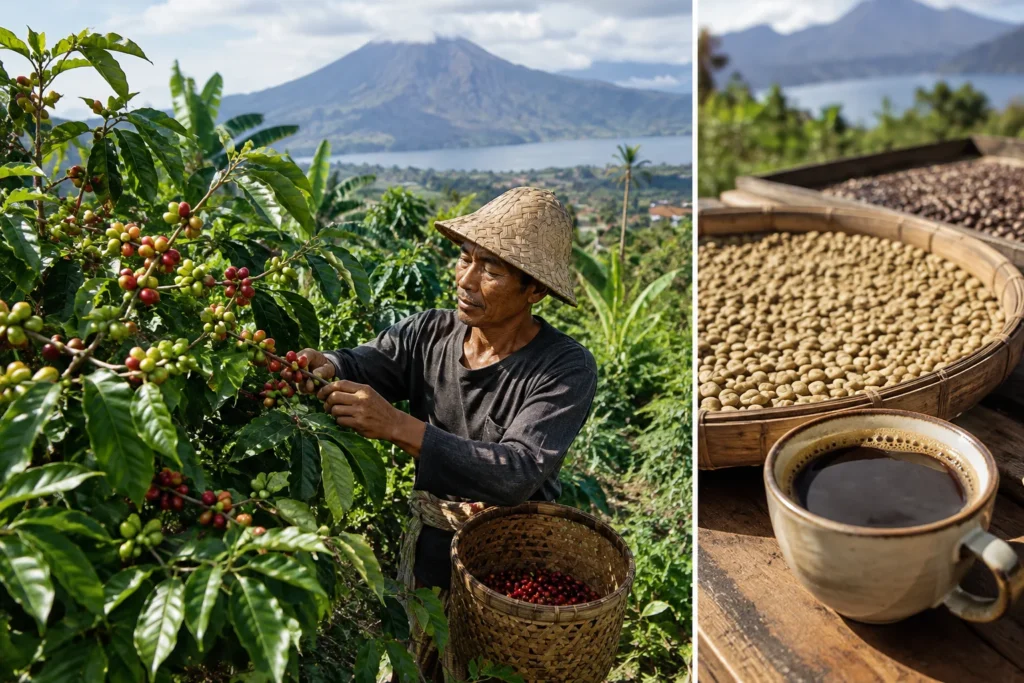
Ripe coffee cherries are usually red or deep red, depending on the variety. Farmers may pick selectively, choosing ripe fruit while leaving greener cherries to mature. This takes time and repeated visits to the same trees, but it helps create a more consistent batch. In practice, the level of sorting and picking method depends on the farm, labour availability and the quality target.
Sorting and removing the fruit
After picking, cherries are sorted to remove damaged or unripe fruit. The outer skin and pulp are then removed using a processing method chosen by the producer. Some Kintamani coffee is processed using a wet method, in which the fruit is removed and the beans are fermented or washed before drying. Other producers may use different approaches. Ask the farm which process they use rather than assuming every Kintamani coffee follows one recipe.
Fermentation, washing and drying
In washed processing, fermentation helps loosen the sticky mucilage around the parchment-covered bean. The beans are then washed and dried. Careful drying is important: beans that remain too wet can deteriorate during storage, while uneven drying can affect quality. Drying may take place on raised beds, patios or other suitable surfaces depending on the producer’s setup and weather.
Hulling, grading and roasting
Once dried, the parchment layer is removed to reveal green coffee beans. Producers or processors then sort and grade the beans before roasting. Roasting transforms the green beans into the fragrant brown coffee most people recognise. A lighter roast may highlight acidity and delicate fruit notes, while a darker roast can bring stronger roasted flavours and reduce the perception of brightness.
Who Grows Kintamani Coffee?
Kintamani coffee is closely connected to local farming communities. Traditional farmer organisations known as Subak Abian are part of the agricultural and social context of the region. In Bali, the subak system is widely associated with the organisation of water for rice agriculture, while Subak Abian relates to farmer groups and dryland or plantation agriculture. These community structures can support shared knowledge, coordination and the protection of local agricultural identity.
Research from Universitas Udayana has examined the supply chain and added value of Kintamani Arabica, including a case study in Catur Village. The study is a useful reminder that coffee involves more than the person roasting it: farmers, collectors, processors and sellers all play a role in bringing a product to market. Read the Universitas Udayana study on the Kintamani Arabica coffee supply chain for an academic perspective.
When buying coffee, consider asking where the beans were grown, who processed them and whether the seller can identify the village or farmer group. A clear answer is a good sign of traceability. It also helps visitors understand that local coffee is an agricultural product built on people’s work, not simply a souvenir with a Bali-themed label.
What Happens on a Kintamani Coffee Farm Visit?
A coffee visit can be a relaxed way to learn about highland agriculture. The experience varies widely. Some farms offer a short walk through coffee and spice plants, an explanation of harvesting and processing, and a tasting. Others focus more on a café setting, product sales or a packaged visitor experience.
Before you go, ask what the visit actually includes. Is there a walk through a working farm? Will someone explain the coffee process? Is the tasting included in the price? Are there additional charges for particular drinks or products? If you are interested in the agricultural side, choose a visit that gives time to talk with someone who understands the farm rather than only moving from one tasting cup to the next.
Be respectful when walking around. Follow the host’s instructions, do not pick cherries without permission, avoid stepping between plants and ask before photographing workers or private areas. A farm is first a workplace and a source of income for local families; the visitor experience comes second.
How to Taste Kintamani Coffee Like a Curious Traveller
You do not need specialist equipment or a vocabulary that sounds like a wine competition judge. A simple tasting can help you notice the differences between coffees.
Buying Kintamani Coffee: What Should You Check?
If you want to take local coffee home, look beyond the packaging. Freshness and traceability matter more than a dramatic volcano illustration.
- Origin: Ask whether the beans are genuinely from Kintamani and, if possible, which village or producer supplied them.
- Bean type: Check whether the product is 100% Arabica or a blend.
- Roast date: A recent roast date is more useful than a vague best-before date alone.
- Whole bean or ground: Whole beans usually retain aroma longer when stored properly. Buy ground coffee if convenience matters more.
- Roast level: Choose light or medium if you want to explore brighter flavours; choose darker if you prefer a heavier roasted profile.
- Packaging: Look for a sealed bag with clear product information and storage advice.
- Price and quantity: Compare the weight and quality, not only the price printed on the front.
Kintamani Coffee and the Wider Highland Food Culture
Coffee is only one part of the region’s agricultural identity. Kintamani is also known for highland produce, including citrus and vegetables grown in cooler conditions. Farms and village markets connect visitors with the everyday economy of the caldera, where agriculture is not a decorative backdrop but an important part of local life.
Our guide to what grows in Kintamani explores other crops found in the highlands. You can also learn about the relationship between the surrounding communities and the lake in our article on why Lake Batur matters to Bali.
For travellers planning a broader day around the area, the Batur Geopark Museum visitor guide offers another way to understand the landscape and its geological story. Combining a coffee stop with scenic viewpoints or a museum visit can make a more rounded Kintamani day than rushing through several photo stops.
Can You Visit a Coffee Farm After Mount Batur Sunrise Trekking?
It may be possible, depending on your trekking schedule, the farm’s opening hours and the location of your accommodation. Many sunrise experiences finish in the morning, leaving time for another stop before returning to your hotel. However, do not assume every package includes a coffee farm visit or that every farm is open when you arrive.
If you want to add a visit, tell your organiser before the activity and ask whether the stop is included, optional or arranged separately. Confirm whether tasting is complimentary, whether purchases are expected and how much time is available. If you are travelling with a group, make sure everyone is comfortable with the extra stop.
For a guided sunrise experience in the area, check the Mount Batur booking details and share your preferred date and accommodation location. You can then ask what can realistically be included in the morning plan.
Frequently Asked Questions About Kintamani Coffee
Is Kintamani coffee Arabica or Robusta?
The protected Kopi Arabika Kintamani Bali product is Arabica. Other coffee types may be sold in Bali, so check the label and origin if you specifically want Kintamani Arabica.
What makes Kintamani coffee different?
Its identity is linked to the Kintamani highland growing area and its geographical indication. The coffee is often described as clean and bright, with citrus-like notes, although flavour varies by farm, processing, roast and brewing method.
Is Kintamani coffee officially recognised?
Yes. Kopi Arabika Kintamani Bali is registered as an Indonesian geographical indication. The registration connects the product’s name and characteristics with its geographical origin and producer community.
Is Kintamani coffee acidic?
It can have a noticeable, clean acidity, often described as citrus-like. Acidity is not necessarily an unpleasant sour taste; in specialty coffee it can contribute freshness and balance.
Can visitors see coffee plants in Kintamani?
Yes, some farms and visitor experiences allow guests to see coffee plants and learn about cultivation or processing. Ask in advance what the visit includes, as not every coffee shop is located on a working farm.
When is coffee harvested in Kintamani?
Harvest timing can vary with elevation, weather and farm conditions. Ask the farm or local producer about the current harvest rather than relying on one fixed month for the entire region.
Can I buy Kintamani coffee to take home?
Yes. Look for clear origin information, a roast date, suitable packaging and details about whether the coffee is whole bean or ground. If traceability matters, ask which village or producer supplied it.
Is a coffee farm visit included in a Mount Batur sunrise tour?
Not automatically. Some itineraries may offer a coffee stop, while others return directly or include different stops. Confirm the arrangement with the operator before booking.
Final Thoughts: Take a Little Kintamani Home in Your Cup
Kintamani coffee offers a simple way to connect with the highlands beyond the famous sunrise viewpoint. Its character comes from a combination of place, farming knowledge, harvest decisions and careful processing. Learning about the geographical indication, meeting the people involved and tasting the coffee with a little context can turn an ordinary café stop into a more meaningful part of a Bali trip.
Whether you prefer a bright black coffee or a milky cup after an early start, take time to ask where the beans came from. Support sellers who can explain their sourcing, respect the people working on the farm and enjoy the fact that the landscape around Mount Batur produces more than memorable views. To explore the wider Kintamani and Mount Batur region, visit our Bali highland adventure guide and plan a visit that leaves room for local stories as well as photographs.